
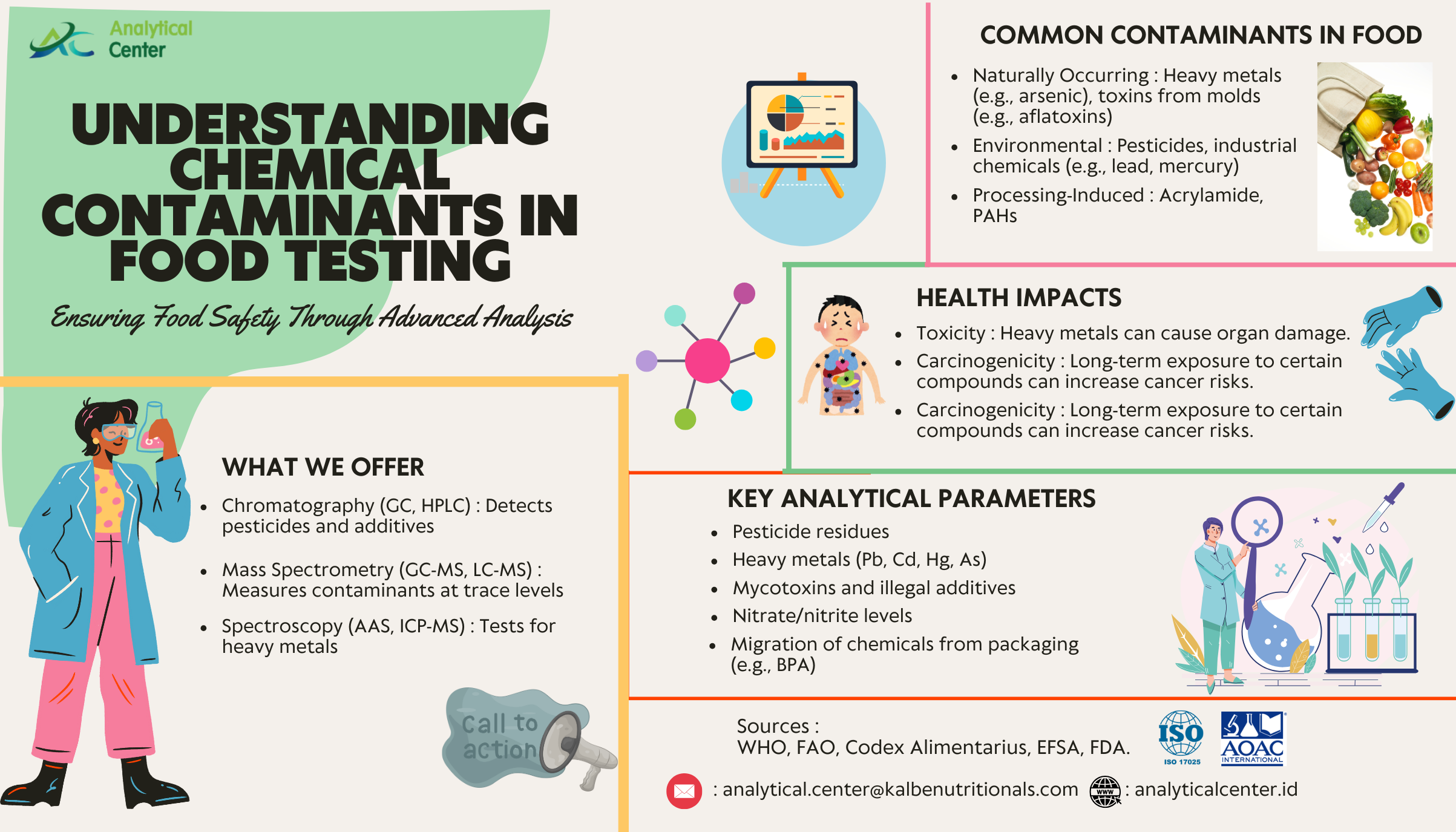
Understanding Chemical Contaminants in Food Testing
Chemical contaminants in food pose a significant challenge for ensuring food safety and consumer health. These contaminants can enter the food supply chain during production, processing, or packaging, making their identification and quantification crucial. This article provides a concise overview of common food contaminants, their potential impacts, and how chemical testing laboratories play a vital role in their detection.
Types of Chemical Contaminants are generally categorized into three types:
1. Naturally Occurring Contaminants :
· These include toxins produced by microorganisms, such as aflatoxins in grains, or naturally occurring heavy metals like arsenic in rice.
· Such contaminants can be harmful in small amounts and require close monitoring.
2. Environmental Contaminants :
· Pesticides, industrial chemicals, and heavy metals (e.g., lead, cadmium, mercury) often contaminate food through polluted air, soil, or water.
· Prolonged exposure to these substances can lead to health risks, including neurotoxicity and organ damage.
3. Processing-Induced Contaminants :
· During food processing, harmful compounds like acrylamide (formed in frying) or polycyclic aromatic hydrocarbons (from grilling) may develop.
· These compounds can pose long-term health risks, including carcinogenic effects.
Impact of Chemical Contaminants
Chemical contaminants can have various adverse effects on human health, ranging from acute poisoning to chronic diseases. For example :
· Toxicity :
Heavy metals can cause organ damage.
· Carcinogenicity :
Long-term exposure to certain compounds can increase cancer risks.
· Reproductive and Developmental Effects :
Some chemicals may interfere with hormonal balance or fetal development.
How Chemistry Labs Detect Contaminants?
Advanced analytical methods are essential for detecting and quantifying contaminants in food products. Key techniques include:
1. Chromatography :
Techniques like gas chromatography (GC) and liquid chromatography (LC) separate and identify complex mixtures, such as pesticide residues.
2. Mass Spectrometry (MS) :
Often coupled with chromatography, MS detects contaminants with high precision, even at trace levels.
3. Spectroscopy :
Techniques like atomic absorption spectroscopy (AAS) and inductively coupled plasma mass spectrometry (ICP-MS) are used to measure heavy metal concentrations.
Ensuring Food Safety
Chemical food testing ensures compliance with regulatory standards set by bodies like the FDA, EFSA, and Codex Alimentarius. It also helps manufacturers maintain consumer trust by delivering safe and high-quality products.
Conclusion
Understanding and addressing chemical contaminants in food testing is critical for public health and safety. Through advanced analytical techniques, chemistry labs provide reliable data to identify and mitigate risks, ensuring the food we consume meets stringent safety standards.
Analytical Parameters in Chemical Contaminant Testing
In food testing, laboratories assess a wide range of analytical parameters to identify and quantify chemical contaminants. Some of the key parameters include:
1. Pesticide Residues :
Analysis of organophosphates, organochlorines, pyrethroids, and other pesticides commonly used in agriculture.
2. Heavy Metals :
Detection of lead (Pb), cadmium (Cd), mercury (Hg), and arsenic (As) to ensure levels comply with safety standards.
3. Mycotoxins :
Monitoring aflatoxins, ochratoxins, fumonisins, and other toxins produced by molds.
4. Processing-Induced Contaminants :
Testing for compounds such as acrylamide, furan, and polycyclic aromatic hydrocarbons (PAHs) that form during food processing.
5. Illegal Food Additives :
Identification of banned substances like harmful synthetic dyes, borax, formalin, and other prohibited chemicals.
6. Nitrates and Nitrites :
Measuring levels of these compounds in processed meats, which can form carcinogenic compounds when exceeding limits.
7. Allergens :
Detection of allergenic substances such as gluten, peanuts, dairy, or other ingredients that may pose risks to sensitive individuals.
8. Preservatives :
Quantifying levels of preservatives like benzoic acid, sorbic acid, and sulfites to ensure compliance with regulatory limits.
9. Environmental Contaminants :
Analysis of pollutants such as dioxins, polychlorinated biphenyls (PCBs), and volatile organic compounds (VOCs).
10. Chemical Migration from Packaging :
Assessing levels of chemicals like bisphenol A (BPA) or other materials that may leach from packaging into food.
These parameters are analyzed using validated methods based on international standards such as ISO, AOAC, or Codex Alimentarius, ensuring accuracy and reliability in food safety testing.