
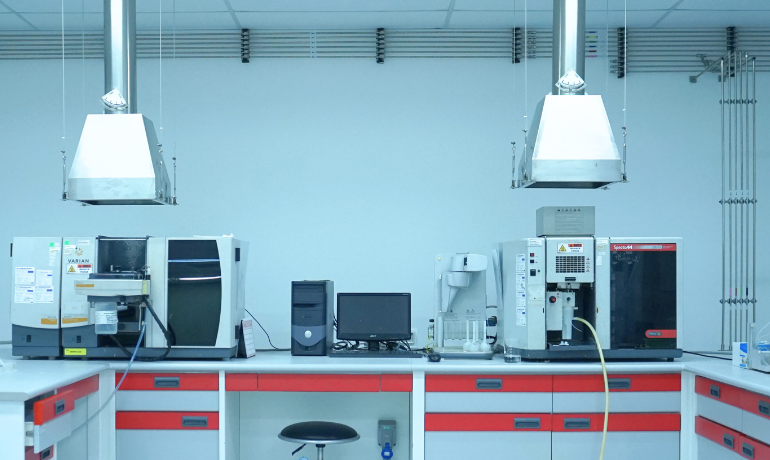
What is AAS?
AAS (Atomic
Absorption Spectroscopy) is an analytical technique used to measure the
concentration of metal elements in a sample. Metal elements in the sample are detected
through light absorption by atoms in a free state. AAS can measure metal
concentrations in very small amounts, even at the part per billion (ppb) level.
How AAS
Works
In AAS
measurements, samples containing metals are atomized or converted into free
atoms through heating in a flame or graphite furnace. These free atoms then
absorb light emitted by a light source, such as a hollow cathode lamp, at a
specific wavelength corresponding to the analyzed element. This light
absorption causes a reduction in measurable light intensity, and this reduction
is proportional to the concentration of the element in the sample.
The Role of
AAS in Metal and Mineral Analysis
AAS
analytical techniques are widely used in various fields, such as environmental
monitoring, food safety, medicine, and the metal industry. AAS is highly
effective in detecting toxic metals such as lead (Pb), mercury (Hg), arsenic
(As), and cadmium (Cd), playing an important role in quality control and
compliance with health and environmental regulations.
AAS in the
Food Industry
Atomic
Absorption Spectroscopy (AAS) plays a vital role in metal and mineral analysis
in the food industry. This technique is used to detect and measure heavy metal
concentrations and essential minerals in food products, ensuring safety and
quality before consumption by the public. In the food industry, AAS has the
following roles:
1.
Detection of Heavy Metal
Contaminants
Lead (Pb) and Cadmium (Cd): AAS is used to measure the levels of heavy metal contaminants such
as lead and cadmium in food products. Research shows that the Graphite Furnace
Atomic Absorption Spectrophotometry (GFA-AAS) method is effective in
determining Pb and Cd levels, ensuring that their concentrations remain below
regulatory limits, thus making the products safe for consumption.
2.
Analysis of Essential
Mineral
Copper (Cu) and Zinc (Zn): In addition to detecting heavy metals, AAS is also used to analyze
essential mineral content such as copper and zinc in food products. These
minerals are important for human health, and AAS helps ensure that their levels
meet established nutritional standards.
3.
Monitoring Contamination
in Seafood
Green Mussels: Seafood
products like green mussels are prone to heavy metal contamination, such as
chromium (Cr) and lead (Pb). AAS is used to analyze the levels of these metals
in mussels, ensuring that contamination levels do not exceed safety limits set
by the Indonesian Food and Drug Authority (BPOM) and the Indonesian National
Standard (SNI).
4.
Supervision of Dairy
Products
Sweetened Condensed Milk: In dairy products like sweetened condensed milk, AAS is used to measure
metal contents such as lead (Pb) and iron (Fe). This analysis is important to
ensure that the products are free from heavy metal contamination and safe for
consumption, following standards set by SNI and BPOM.
With high
sensitivity and accuracy, AAS is a reliable tool in monitoring food quality and
safety, helping the industry ensure that produced goods meet applicable health
and safety standards.
Refrence :
- Thermo Fisher Scientific. Atomic Absorption Spectrometry (AAS) Information. Diakses pada 1 Februari 2025. https://www.thermofisher.com
- Oktavia, Dwina Putri. Dkk. 2023. Determination Of Contamination Levels Of Heavy Metals Lead (Pb) And Cadmium (Cd) In Food Samples By Carbon Atomic Absorption Spectrophotometry (Graphite Furnace Atomizer AAS/GF-AAS). Jurnal Kimia FMIPA UNMUL. Diakses pada 1 Februari 2025. https://jurnal.kimia.fmipa.unmul.ac.id/
- Suci, Ayrus. 2021. Penentuan Kandungan Logam Berat Cu Dan Zn Pada Sampel Air Limbah Kelapa Sawit Dengan Metode Aas (Atomic Absorption Spectrophotometry). UNIVERSITAS JAMBI : FAKULTAS SAINS DAN TEKNOLOGI.
- Zahro, Kholisatuz. 2023. Analysis of Cr and Pb in Green Mussels from the Fish Auction Site, Klidang Lor, Batang Using AAS (Atomic Absorption Spectrophotometry). Indonesia Journal of Chemical Science (3).